

AvatarHype, also searched as Avatar Hype, sells training for creating AI advertising. Start with its official course page if you want the academy. This guide helps you compare learning a production method with creating content in Clout Marketing Studio.
Published by Clout, a competing creative platform. We checked public course information on October 24, 2026, without purchasing lessons or testing its generation workflow. The exercise below is original planning material, not an AvatarHype lesson or a generated result.
For a countable product bundle, use the knolling layout guide and inventory worksheet before making the ad.
What is AvatarHype
AvatarHype is an AI ad academy rather than a bundle of generation credits. Its advertised formats include realistic UGC, animated ads, voice-over, podcast-style ads and DualCast conversations. The Strategist, 6C and Image Architect are course resources for developing ideas and prompts.
That distinction matters when you arrive from an ad showing a convincing presenter. Decide whether you need instruction, production software, or both. A course can help explain decisions; you still need to operate the relevant tools, review takes and assemble a finished creative.
AvatarHype pricing and separate production costs
The official English page displayed these one-time course prices on October 24, 2026, with lifetime access:
| Course | Displayed USD price |
|---|---|
| Realistic UGC | $79 |
| Animated Ads | $59 |
| Complete Pack | $99 |
Generation credits cost extra. Optional voice cloning adds a $7 module and an external tool around $9/month. Animated Ads is being re-recorded; the current offering describes a 20-minute lesson and eight-prompt guide. Confirm the latest curriculum and checkout before paying. We have not verified the advertised limited-time generation promotion.
Budget for a complete ad, including rejected takes. Separate the training purchase from image attempts, video attempts, voice, editing and your review time. A promotional cost for one clip is not the cost of delivering an approved campaign.
AvatarHype vs Clout for your next ad
| What you need | Route to evaluate | Useful first deliverable |
|---|---|---|
| Structured instruction | AvatarHype curriculum and lesson previews | A lesson you can apply to your own product |
| An original recurring presenter | Clout AI Influencer | Approved identity references and a short presenter take |
| A product campaign | Clout Marketing Studio | A clear product image and one demonstrable benefit |
| Image and video experiments | Clout Image and Video | One accepted still and a controlled motion test |
| A dramatic brand story | Clout AI Cinema | A short sequence with continuity and an ending |
Training and software can serve the same project. Compare the actual steps you need to complete, the current Clout plan and the quote for your chosen operation. This is a workflow comparison, not a claim that the two purchases include equivalent features or credits.
Build three ad hooks around one real demonstration
Use a refillable desk pen as a planning example. The brief is a short vertical ad that shows the cap coming off, a line being drawn and the cap returning. Preserve the barrel color, cap clip and product proportions. Supply your own approved reference before generating anything.
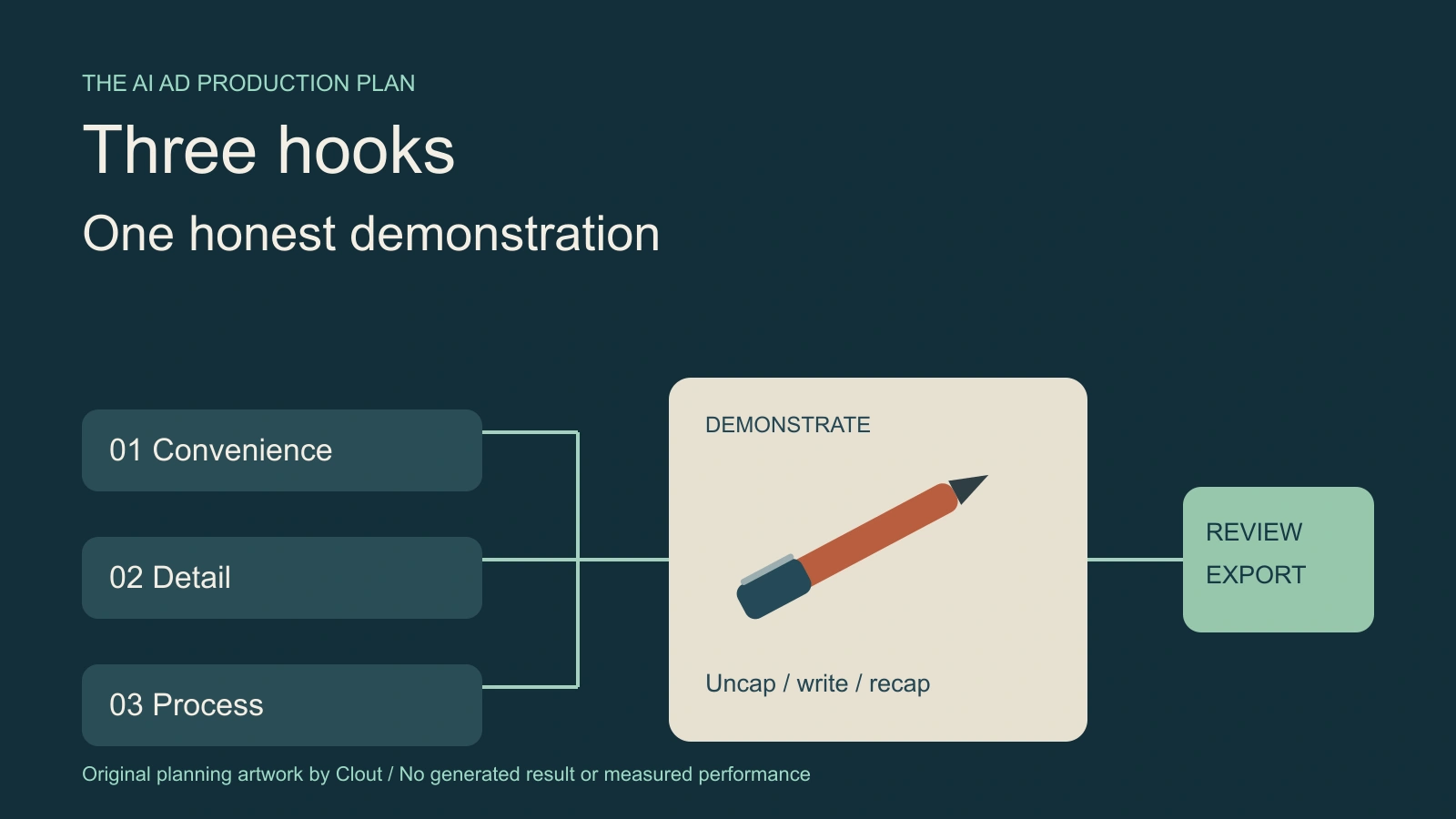
Choose three openings that use the same honest demonstration. Convenience: “A pen that belongs on your desk.” Detail: “Start with the line, then look at the finish.” Process: “Uncap, write, recap.” These are draft creative directions, not proven winning hooks. Replace them with accurate language for the real product and audience.
Keep the demonstration and closing instruction fixed across the first set. Changing the person, product, offer and script at once makes it difficult to understand a later difference in campaign response. Label each exported variation with the hook version, date and source reference.
Write the shot plan before the prompt
- Opening: Show the product clearly while introducing the chosen hook. Keep text away from the platform controls and the product itself.
- Demonstration: Show one visible action. Inspect hand contact, cap geometry, barrel continuity and whether the drawn line follows the pen.
- Close: End on an approved product view with a specific next step. Add verified price or offer details in the edit rather than expecting generated lettering to remain correct.
For a presenter, write a short spoken line that explains what the viewer can actually observe. Avoid scripted personal experience unless it belongs to a real authorized speaker. An AI character can introduce a demonstration without pretending to be a customer reporting a result.
Use this original production direction
Use the approved reference of the refillable desk pen. Keep the barrel, cap clip and proportions consistent. Show one simple uncap-and-write action on plain paper with a fixed close camera. Keep fingers separated and preserve contact between the pen and paper. Do not add product lettering, extra objects or an invented offer. Review the complete returned take before editing.
Adapt this untested direction to the selected tool's supported inputs and duration controls. If the action fails, simplify it: produce a clean product still first, then a smaller movement. Do not hide a changed product by cutting so quickly that viewers cannot inspect it.
Download the ad brief and track accepted work
Use the original ad pilot brief and blank attempt ledger to record reference, hook, model, quoted cost, actual cost, output and review decision. These are Clout-authored resources that work as a planning exercise regardless of your chosen platform.
Review the saved file on a phone with sound on and off. Check the product, lip movement where relevant, captions, music balance, crop and final frame. Record the reason for every rejection with a timestamp. Count an output as accepted only after it meets the delivery brief.
Calculate production spend per accepted ad from actual charges divided by accepted exports. When no export passes review, record zero accepted ads and the spend incurred; do not divide by zero or label failed attempts as finished work. Track editing time separately. Campaign performance needs a separate record of the platform, audience, spend and measured result.
Which route should you choose
If your main gap is knowing how to plan and assemble AI advertising, inspect the course previews and compare the curriculum with that gap. If you already have a brief and need production tools, start with one small Clout workflow and inspect the actual deliverable before expanding the campaign.
For deeper production work, use the AI short drama workflow for dialogue coverage, the multi-shot video guide for connected scenes and the Zirva AI comparison for another creative platform. Keep a single approved reference and an observable acceptance rule throughout.


