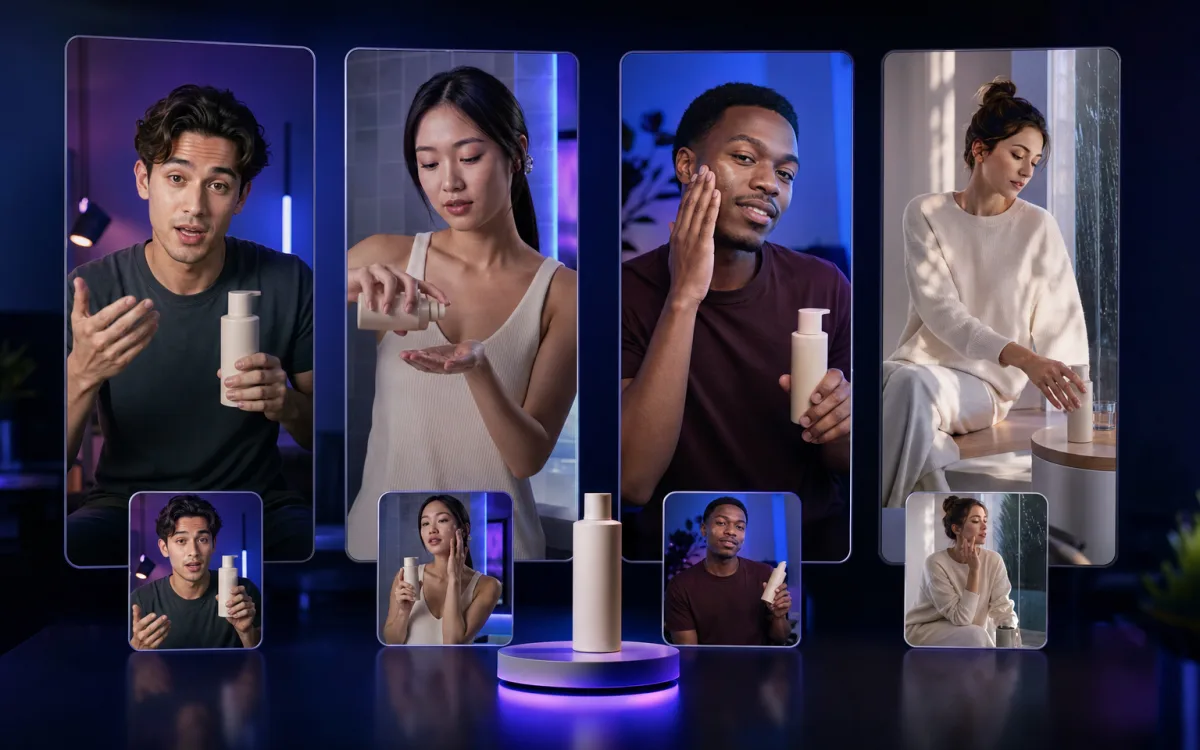
The best AI UGC generators can turn a script, product link, image, or creator persona into short-form ad variations without coordinating a new shoot for every hook. The category now includes avatar video studios, product-in-hand tools, multilingual presenters, template engines, multi-model creative suites, and full AI influencer builders.
Those products should not be ranked by avatar count alone. This guide compares six useful starting points by input, output, persona consistency, product interaction, editing, localization, testing workflow, and commercial fit. It also separates one-off synthetic ads from a recurring creator brand.
Best AI UGC generators at a glance
Choose the tool around the production bottleneck. A performance team may need 30 hook variations around one product. A global company may need the same presenter in many languages. A creator business may need one identity that can publish organic content between paid campaigns.
| Best starting point | Primary buyer job |
|---|---|
| Creatify | Turn product URLs and briefs into editable, batch-tested ads and launch workflows |
| HeyGen | Create polished avatar-presenter UGC and localize it across many languages |
| MakeUGC | Generate product-in-hand, b-roll, script, avatar, and batch ad variations |
| SynthLife | Move an AI persona quickly into templates, lip sync, motion, Reels, and TikTok |
| Affogato | Use a broad image, video, editing, face, product, influencer, and UGC studio |
| Clout | Build one original AI creator, recurring content system, launch, and monetization path |
1. Creatify: best end-to-end AI ad workflow
Creatify has expanded from a URL-to-video generator into a broad ad-production platform. Its official feature page lists product-URL analysis, scriptwriting, more than 1,500 avatars on higher plans, custom avatars, AI influencers, AI humans, product video, editing, batch generation, ad cloning, asset generation, ad intelligence, and direct launch tools.
That combination makes Creatify a strong starting point for ecommerce brands and performance teams whose recurring job is moving from a product page to multiple ads. The editor can change scripts, avatars, voices, b-roll, music, captions, and formats before final export, while higher tiers add competitor research, team access, and campaign tooling.
Read the full Creatify review and Clout vs Creatify comparison to decide whether you need an ad operating system or a creator-brand system.
2. HeyGen: best for multilingual avatar presenters
HeyGen's official AI UGC page focuses on script-to-avatar video, a large presenter library, customizable appearances and settings, consistent delivery, and localization. Its current page advertises more than 1,100 UGC avatars and support for 175+ languages and dialects.
HeyGen is the clearest fit when the core asset is a talking presenter that must be refreshed or translated repeatedly. Test the actual language, voice, emotion, hand movement, product interaction, and caption workflow you need. A convincing English sample does not prove every language or format will meet the same standard.
Read the full HeyGen review and Clout comparison for its updated 2026 credit system, commercial rights, broad content license, and presenter-versus-influencer decision.
3. MakeUGC: best for product-in-hand variation
MakeUGC's official product page combines scripts, more than 1,000 advertised AI avatars, product URL or image inputs, product-in-hand scenes, unboxing and lifestyle formats, b-roll, multiple languages, parallel generation, batch mode, and API plans.
Its live first-party pricing surfaces currently disagree, and the $1 offer renews into a paid subscription. Read the full MakeUGC review and Clout comparison before choosing a plan.
It is relevant to performance teams that want many product-led executions rather than only a presenter reading a script. Its pricing page uses credits alongside changing promotions and model-specific unlimited allowances, so the checkout and pre-generation cost should be treated as the source of truth. Test packaging geometry and hands carefully because product interaction is harder than a static talking-head frame.
4. SynthLife: best for template-led social motion
SynthLife emphasizes identity anchoring, AI persona images, templates, motion transfer, lip sync, TikTok-style cloning, and vertical formats. That makes it a useful shortlist option when the persona already exists and the bottleneck is fast Reels, Shorts, or TikTok production. Read the independent SynthLife review for the dated plan and workflow analysis.
The risk is derivative production. Use trends for pacing or format inspiration without copying another creator's likeness, footage, music, script, or distinctive execution. A fast template should still produce an original ad with accurate claims and the necessary disclosure.
5. Affogato: best broad multi-model production studio
Affogato, previously RenderNet, presents more than 170 image and video models plus AI influencer, UGC, fashion, product, beauty, editing, lip-sync, face-swap, and upscaling workflows. It is the broadest production toolbox in this shortlist. See the current RenderNet and Affogato review for the rebrand and dated pricing.
Model breadth is valuable when an experienced operator already understands scripts, references, generation engines, editing, video continuity, and approval. It can add friction when a beginner needs a clear creator and campaign direction more than another model choice.
6. Clout: best for a recurring AI creator brand
Clout begins before the UGC script. It helps create an original adult persona, define the niche and visual direction, keep the identity stable, generate social photos and first frames, plan recurring formats, and connect the creator to a launch and monetization route. The AI UGC creator workflow explains how to vary the hook or product scene without rebuilding the person.
Choose Clout when the synthetic creator must exist between ads. A recurring persona can publish organic-looking formats, develop an audience promise, front several campaigns, and support brand partnerships, subscriptions, affiliates, products, or services. Choose an ad-first tool when the identity is disposable and production speed around a specific product page is the priority.
Use the AI UGC video workflow and UGC AI ads guide to build the controlled brief before testing any platform.
How to test AI UGC generators
Create one honest product brief with a defined audience, problem, evidence, offer, and prohibited claims. Require each tool to produce a talking-head hook, product-in-hand demonstration, objection response, testimonial-style concept, b-roll cut, and localized variation. Use the same duration and output formats.
Do not score only realism. Measure how quickly the team reaches an approved ad that can survive legal, platform, brand, and performance review.
- Persona quality: face, voice, apparent age, emotion, gestures, lip sync, and identity drift
- Product quality: packaging, label, scale, grip, use, reflections, and continuity across cuts
- Ad quality: hook clarity, claim accuracy, pacing, b-roll, captions, CTA, and native format
- Operations: scripts, URL import, revisions, batch mode, API, team review, and export options
- Economics: attempts, credits, duration, premium models, localization, cleanup, and cost per approved ad
AI UGC still needs honest claims and disclosure
Synthetic UGC should not pretend a generated actor personally used a product, achieved a result, or gave an independent testimonial. Write the asset as a dramatized ad, product explanation, spokesperson script, or creator-style concept unless you have real substantiation and the representation is not misleading.
Use original synthetic people or authorized digital twins. Keep permission records for any real likeness, voice, footage, product, music, and brand asset. Follow the current platform, advertising, and local synthetic-media disclosure rules in every market where the ad runs.
Best AI UGC generator verdict
Creatify has the strongest end-to-end ad-production proposition in this shortlist. HeyGen is compelling for polished multilingual presenters. MakeUGC emphasizes product-led variation. SynthLife is useful for template-driven social motion. Affogato offers the broadest production toolbox. Clout is the better starting point when one original creator must remain coherent across paid and organic content and connect to a broader business.
The correct winner is the workflow that creates the highest number of approved, truthful ads per week without compromising product accuracy, rights, or creator consistency. Run the same brief and calculate the real production cost before committing.
If your UGC strategy needs one recognizable creator instead of a rotating avatar for every ad, build your original AI creator in Clout and test a complete paid-and-organic content batch.


