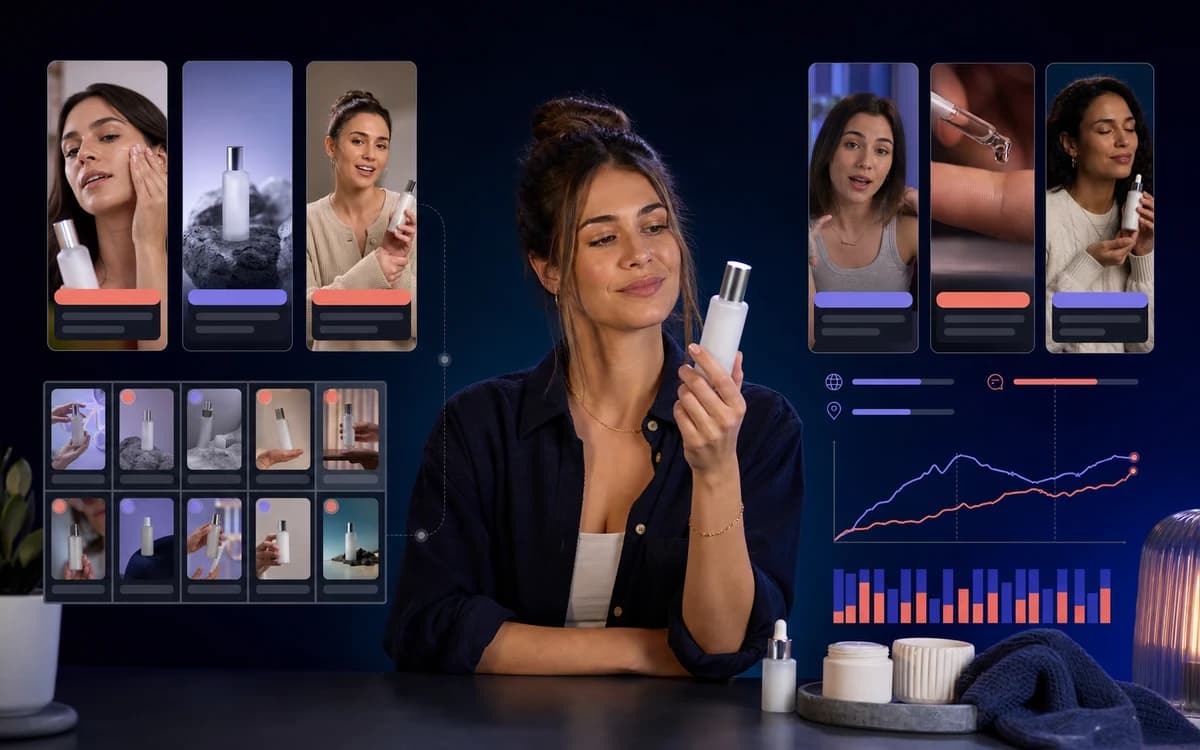
This MakeUGC review evaluates a product built for ecommerce creative volume: turn a script, product URL or image, stock actor, custom avatar, and reference structure into many creator-style video ads. The platform emphasizes product-in-hand scenes, unboxing, reviews, B-roll, multiple hooks, languages, batch production, and API automation.
That is a different job from building an AI influencer brand. MakeUGC can help a paid-media team test more ads; it does not automatically define a unique creator, grow an organic account, build community, or decide what the audience should eventually buy. The correct choice depends on whether the bottleneck is ad production or creator strategy.
What is MakeUGC?
MakeUGC is an AI UGC and ad-generation platform operated by Make Media Limited. Users can provide a script, select from a large advertised actor library, upload a product image or use a URL, create product-in-hand scenes, add B-roll, translate output, edit video, or run multiple variations in parallel.
The current product page also advertises Video Agent, PDF-to-video, image generation, multiple image and video models, custom workflows, batch mode, custom avatars, and API plans. It is aimed at brands, dropshippers, paid-social teams, agencies, and developers who need more creative variations without coordinating a physical shoot for every test.
MakeUGC and Clout overlap in creator-style media but differ in the operating goal. MakeUGC is ad-first and variation-first. Clout is persona-first and creator-business-first. See Clout vs MakeUGC for the direct commercial comparison.
Product-in-hand video and ad variation
MakeUGC's clearest differentiator is synthetic product interaction. The current page says a user can upload an image or paste a product URL, select a frame, and create unboxing, lifestyle, or review-style footage with an AI actor holding or presenting the item. It also encourages testing a product across ten avatars and more than twenty scenes.
Product fidelity must be tested carefully. Labels, dimensions, packaging, dosage, colors, logos, reflective surfaces, hand placement, and how the actor uses the item can drift. Never publish a synthetic demonstration that implies a feature, result, endorsement, or physical behavior the real product does not have.
The platform also supports reference-led rebuilding through Video Agent. Use only an owned or licensed source. Copying an ad's structure can still create copyright, music, likeness, trademark, or platform-reuse issues when the execution remains too close.
Actors, custom avatars, languages, and editing
MakeUGC advertises more than 1,000 actors on its current product page, while some feature and API surfaces state 500+. Treat the live authenticated library and the particular plan as the source of truth. A large stock library is useful for variation but does not give a brand a unique face; another customer may choose the same actor.
Custom avatars can use an owned fictional identity or an authorized real likeness. The Custom Avatar Policy requires rights to every image, voice, music track, performance, brand reference, and likeness and prohibits real-person replication without signed consent.
MakeUGC advertises 50+ languages, lip sync, captions, music, B-roll, and trims. Test pronunciation, pacing, voice, product names, subtitle layout, disclosure, and cultural adaptation in every target language. Use the best AI UGC generator guide to compare MakeUGC with HeyGen, Creatify, SynthLife, Affogato, and Clout.
MakeUGC pricing conflicts in July 2026
MakeUGC currently exposes different price tables on live first-party pages. One feature page lists Startup at $49 monthly, Growth at $69, and Pro at $119, with 5, 10, and 20 AI-generated videos. The primary product and promotional pricing pages list $59, $79, and $149 with 500, 1,000, and 2,000 monthly credits. The Pro page also displays a $1 trial that renews at $149.
| Live surface | Prices shown on July 17, 2026 |
|---|---|
| Feature-page table | $49 Startup, $69 Growth, $119 Pro |
| Main product table | $59 Startup, $79 Growth, $149 Pro |
| API | $99 for 2,000 monthly credits; $299 for 6,000 |
| Enterprise | Custom pricing and terms |
The main FAQ says subscriptions renew automatically, unused monthly credits expire instead of rolling over, and extra credit packs can be purchased. Supported “unlimited” models vary by plan and promotion; standard-queue access can differ from credit-backed priority generation. The advertised 365-day unlimited promotion ends when the plan is canceled or downgraded.
Because the prices and units differ, verify the authenticated checkout rather than choosing from a cached table. Record the plan, full renewal price, billing period, credits, supported models, output limits, concurrency, trial end, cancellation, and per-action estimate.
How the $1 MakeUGC trial works
MakeUGC advertises a $1 promotional entry. Its Trial Policy makes the trial part of the subscription relationship and incorporates the pricing and subscription terms. The live product FAQ says unlimited generation does not activate during the $1 trial; it begins after the first full billing cycle.
The visible Pro offer currently says it renews at $149. That means the trial price is not the monthly price. Before entering payment details, confirm the exact trial length, included credits or models, renewal date, renewal amount, cancellation deadline, and whether generated assets remain accessible after cancellation.
Output ownership, input license, and model training
MakeUGC's current Terms of Service say users retain ownership of inputs and own outputs generated while compliant. MakeUGC assigns its copyrights in outputs to the user and grants a perpetual, worldwide, royalty-free, assignable, sublicensable commercial license without attribution. This is unusually strong output-rights language for the category.
Inputs receive a non-exclusive, worldwide, royalty-free, transferable, sublicensable license for hosting, processing, analysis, transformation, service improvement, security, and compliance. The terms say this input license ends on deletion or account closure except where legal, security, or compliance retention applies.
The Privacy Policy says prompts and interactions may be used to improve services, including model training, but users can email support to opt out. A separate Custom Avatar Policy says MakeUGC does not claim ownership of custom-avatar content and uses a service-delivery license rather than commercial exploitation. Rights-sensitive teams should keep the opt-out confirmation and compare every incorporated policy.
Claims, consent, disclosure, and ad compliance
MakeUGC prohibits unlawful, harmful, pornographic, deceptive, infringing, impersonating, and misleading commercial uses. Its terms explicitly prohibit omitting AI disclosure where law requires it. The custom-avatar policy requires signed consent for a real person's likeness.
UGC-style output can look like a testimonial even when no human used the product. Do not invent customer experience, before-and-after results, medical effects, earnings, scarcity, or endorsements. Label synthetic presenters, disclose sponsorship, substantiate claims, and review the ad policies for the product category and target market.
MakeUGC strengths
- Product-led ad workflow: URLs or images, product-in-hand scenes, demos, and unboxing formats.
- Variation volume: many actors, scenes, hooks, languages, parallel jobs, and batch mode.
- Production breadth: scripts, images, B-roll, editing, video models, custom workflows, and API.
- Strong output terms: current terms state ownership, copyright assignment, and broad commercial rights.
- Custom-avatar policy: explicit consent and rights-clearance requirements.
MakeUGC limitations and watch-outs
Pricing clarity is the largest immediate issue. Two current first-party tables show different monthly figures and units, promotions can change model access, and the $1 entry renews at a much higher amount. Save the live checkout before paying.
Stock actors and repeatable ad formats can also become generic. A large output volume is useful only when the team has a testing taxonomy, clear claims, reliable product fidelity, performance attribution, and a process for retiring fatigue. Vendor case-study numbers are not a forecast for a new account.
Finally, MakeUGC is not an organic creator operating system. Use the content calendar and monetization guide if the objective extends beyond paid-ad variations.
MakeUGC vs Clout
Choose MakeUGC when the team needs ecommerce ad variants, stock actors, product-in-hand scenes, reference-led rebuilding, localization, batch generation, or an API. It is designed to feed a paid creative-testing machine.
Choose Clout when the goal is one original AI influencer with a differentiated identity, recurring organic content, a launch path, and monetization strategy. Clout can support creator-led product concepts, but it is not a substitute for MakeUGC's high-volume ad-production specialization.
Use the AI UGC creator workflow to plan claims, formats, review gates, and batch measurement before scaling either path.
MakeUGC review verdict: is it worth it?
MakeUGC is worth testing for ecommerce and paid-social teams that already have products, claims review, a creative testing plan, and reliable performance measurement. Its product-in-hand focus, variation tools, languages, batch workflow, and strong output-rights language make it a credible specialist.
Before paying, reconcile the price table with checkout, understand the $1 renewal, calculate cost per approved ad, test product accuracy, document every real-person consent, and opt out of model training if required by the campaign.
If the priority is a unique creator brand rather than a paid-ad factory, build the AI influencer in Clout and compare its complete social workflow with MakeUGC's product-led variation system.