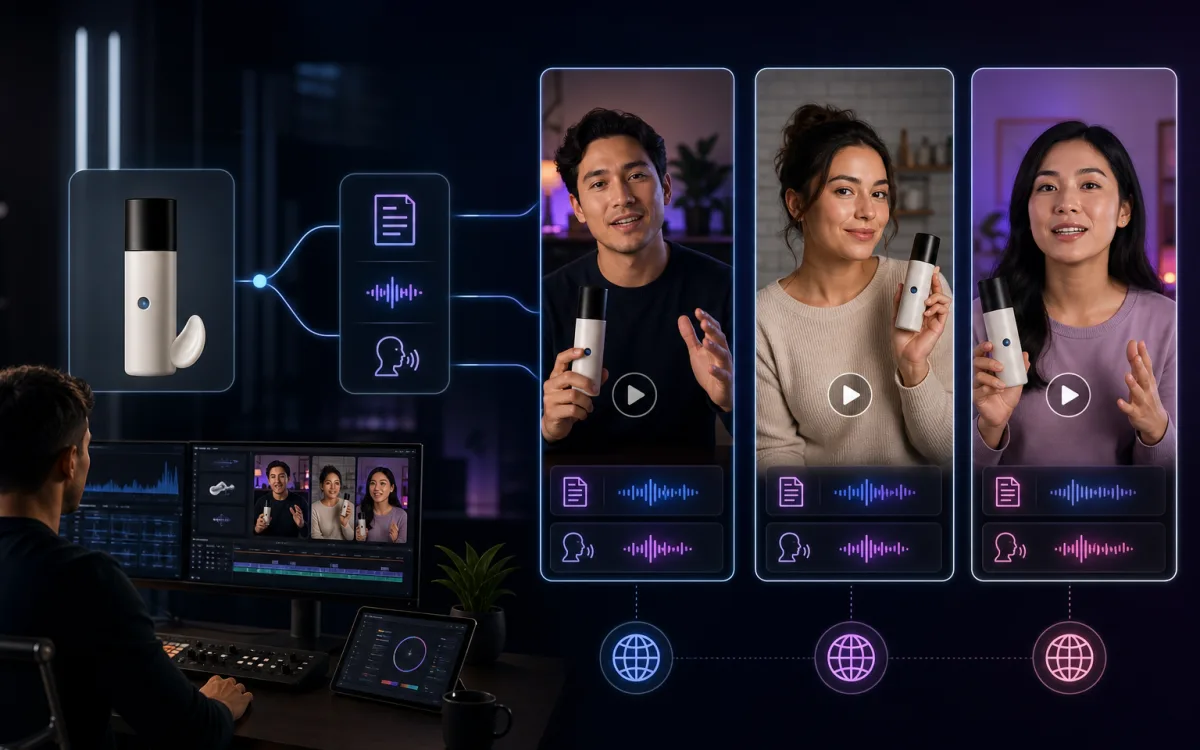
Creatify has grown beyond the narrow idea suggested by the phrase AI avatar generator. The current product combines URL-to-video, avatar and influencer creation, product ads, scripts, images, video, editing, batch variants, competitor ad research, launch tools, and higher-tier ad operations.
This Creatify AI review evaluates that live public proposition, current pricing, strengths, limits, consent position, and buyer fit. It also explains the difference between an ad-production platform and a persona-first creator system such as Clout.
What is Creatify AI?
Creatify is an AI ad-production platform for creators, marketers, ecommerce brands, and agencies. Its official feature page says users can start from a product URL, product image, script, or brief, then generate creative with avatars, voices, product assets, b-roll, captions, music, and multiple aspect ratios.
The platform now reaches beyond creation. Higher-tier public features include ad templates, batch mode, ad cloning, competitor research, creative insights, team collaboration, media-buying assistance, and launch connections. That makes the product closer to an ad operating system than a standalone talking-avatar tool.
- Inputs: product URLs, product images, scripts, briefs, existing ads, photos, and avatar footage
- Creation: scripts, avatars, AI influencers, AI humans, product video, image ads, b-roll, voice, and captions
- Control: scene-level editing, avatar and voice swaps, music, formats, revisions, and batch variants
- Operations: templates, competitor ad research, insights, launch tools, teams, and API options
Creatify URL-to-video and UGC workflow
The flagship path starts from a product page. Creatify extracts available product information and media, proposes scripts and scenes, pairs the message with an avatar or product treatment, and assembles an ad. The user can revise the script, actor, voice, visuals, captions, music, b-roll, and aspect ratio before export.
The dedicated AI UGC page positions the workflow around fast ad testing rather than long-form video production. Batch mode and ad cloning help create new hooks, avatars, and formats around a proven structure. Use those features to test ideas, not to reproduce another advertiser's protected footage or distinctive expression.
| Creatify capability | What to verify |
|---|---|
| Product URL to ad | Imported facts, source images, claims, price, offer, and brand accuracy |
| AI actors and influencers | Identity, delivery, emotion, gestures, lip sync, and audience fit |
| Product interaction | Packaging, scale, grip, label, use, continuity, and realism |
| Batch and ad clone | Originality, variable control, credit cost, and review throughput |
| Localization | Translation, pronunciation, voice, timing, captions, and local claim compliance |
Creatify AI actors, influencers, and custom avatars
Creatify's current AI influencer page advertises more than 1,500 available avatars on higher tiers, text-generated synthetic people, image-based avatars, and video-based digital twins. The platform positions these identities for UGC ads, product demos, social content, brand ambassadors, localization, and A/B testing.
The distinction between a stock actor, a synthetic prompt-generated person, and a real-person digital twin matters. A stock actor comes with platform-specific licensing. A synthetic identity should still be screened for accidental resemblance. A digital twin requires explicit permission from the person and clear control over who can generate with it.
Creatify's AI ethics page says stock avatars are based on actors who provided written consent and custom avatars require explicit consent. Buyers should still review the current terms, campaign scope, and any restrictions that apply to a specific asset or plan.
If one identity will front many campaigns, score it with the consistent-character workflow rather than judging only one talking-head sample.
Where Creatify is strongest
The clearest strength is workflow coverage. An ecommerce operator can move from product page to script, actor, voice, scenes, edits, variants, and launch without assembling many unrelated tools. The large public actor and model libraries also allow rapid testing across demographics and creative styles.
Creatify is especially relevant to paid-media teams because the product does not stop at a generated file. Batch variation, ad inspiration, competitor tracking, creative insights, team review, and launch connections can reduce handoffs between research, production, and campaign execution.
Compare the platform with the best AI UGC generators using one controlled product brief and a real weekly output target.
Creatify limitations and tradeoffs
Breadth increases the number of features, models, credits, and quality levels a buyer must understand. A strong avatar does not guarantee an accurate product-in-hand scene. A fast URL import can repeat an outdated price or unsupported claim. A batch tool can multiply weak creative just as quickly as strong creative.
The public support material also reflects a fast-changing product. On the research date, official pages differed on some credit-renewal and duration examples. The platform says the exact cost appears before render, so use the live dashboard and checkout as the source of truth rather than assuming an old help-center calculation still applies.
Creatify can create a consistent avatar and social content, but its center of gravity is advertising. It does not automatically define a differentiated creator niche, audience promise, organic content pillars, community loop, fan relationship, or long-term monetization strategy.
The AI UGC creator workflow covers that missing persona-to-campaign layer and helps prevent a batch tool from multiplying disconnected actors or claims.
Creatify pricing in 2026
On July 17, 2026, the official Creatify pricing page listed a free plan with 10 monthly credits and watermarked exports, Starter at $39 per month with 100 credits, and Pro at $99 per month with 300 credits. Pro listed 1,500 actors, three custom avatars, more templates and models, team access, competitor tracking, and ad-launch features. Enterprise pricing was custom.
The page advertised annual savings and allowed higher Pro credit quantities. Credit cost depends on the tool, duration, revision, and model; official documentation says the product displays the exact cost before render. Verify renewal rate, rollover or expiry, seats, brand spaces, premium-model access, custom-avatar slots, watermark rules, and API pricing at checkout.
- Test the free tier for workflow fit, but account for its watermark and limited library
- Record pre-render credit cost for each selected model and duration
- Separate drafts from approved ads when calculating output volume
- Include scene revisions, localization, captions, cleanup, and human review
- Check which ad research and launch features are actually included in the chosen tier
Creatify vs Clout
Creatify and Clout overlap around synthetic people, short-form creative, and commercial content, but the product journeys begin in different places. Creatify begins with the campaign or product and assembles an ad. Clout begins with the creator identity and assembles a repeatable brand and content system.
Choose Creatify when the bottleneck is producing, editing, varying, localizing, researching, and launching many ads. Choose Clout when the bottleneck is creating one original AI influencer, maintaining that identity across paid and organic content, and connecting the persona to a launch and monetization direction. Read the full Clout vs Creatify comparison for the decision framework.
| Primary requirement | Better starting point |
|---|---|
| Product URL to multiple ad variants | Creatify |
| Large avatar and ad-template library | Creatify |
| Ad research, editing, batch production, and launch tooling | Creatify |
| Original recurring creator identity and organic content system | Clout |
| Creator niche, audience, launch, and monetization direction | Clout |
How to test Creatify before paying
Build one honest product brief, then use the AI UGC video workflow to create a talking hook, product demonstration, objection response, b-roll cut, alternate CTA, and localized version. Keep the claim, product assets, duration, and output formats fixed.
Review every imported fact and generated scene. The platform should not invent a product result, alter the package, imply a synthetic actor had a real experience, or publish a translated claim that is not approved for the local market.
- Measure script and first-draft quality before editing
- Inspect face, voice, emotion, gestures, hands, product geometry, and lip sync
- Track credits and time for draft, revision, localization, and approved export
- Test scene-level changes without rerendering unnecessary parts
- Confirm commercial rights, consent, disclosure, privacy, and brand-safety requirements
Creatify AI review verdict
Creatify is a credible, unusually broad shortlist option for brands and agencies that need high creative-testing velocity. URL-to-video, a large actor library, custom avatars, AI influencers, product creative, editing, batch variants, research, insights, and launch tools cover much of the paid-ad lifecycle.
The breadth does not remove the need for product accuracy, truthful claims, original creative, consent, and human review. Clout is the stronger alternative when the buyer is not primarily assembling ads around products, but building one virtual creator into a durable social identity and business.
Use the UGC AI ads checklist to score both workflows, then create your original AI influencer in Clout if creator continuity matters more than ad-operations breadth.