This Ryla AI review starts with its clearest promise: create one AI influencer quickly, keep the identity recognizable, and generate social photos or video through templates instead of learning a complex model stack. That is an attractive proposition for a creator who values speed and does not want to prompt every scene from scratch.
The buying decision still requires more care than the headline suggests. Ryla's public pages currently show different free-credit and promotional displays, generation actions consume very different amounts, some advanced identity and output options are tiered, and “perfect consistency” is marketing language that should be tested with a real batch.
What is Ryla AI?
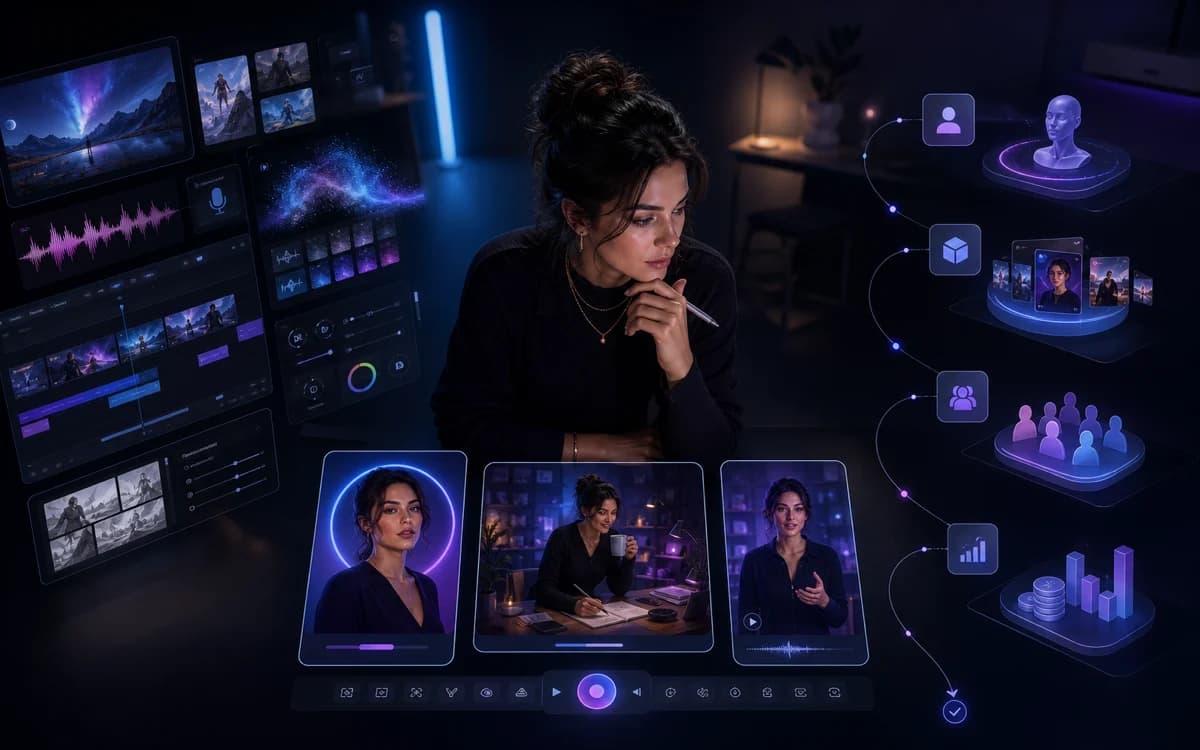
Ryla is an AI influencer creation platform for building a fictional character or using an authorized reference, then generating photos, reels, talking-head clips, and video around that identity. The product emphasizes a no-prompt or low-prompt experience: select appearance attributes, choose a template or scenario, and produce platform-ready media.
The official how-it-works page describes a five-stage journey covering character creation, templates, content generation, and publication. Character controls include age, eyes, hair, face shape, body type, and voice. The studio pages advertise photos, photo-to-video, outfits, lip sync, AI voices, video swap, upscaling, and template-led scenes.
Ryla overlaps directly with Clout, but the center differs. Ryla leads with fast content production and templates. Clout leads with an original persona's niche, content logic, launch, and monetization system. The full choice is covered in Clout vs Ryla.
Ryla character creation and consistency
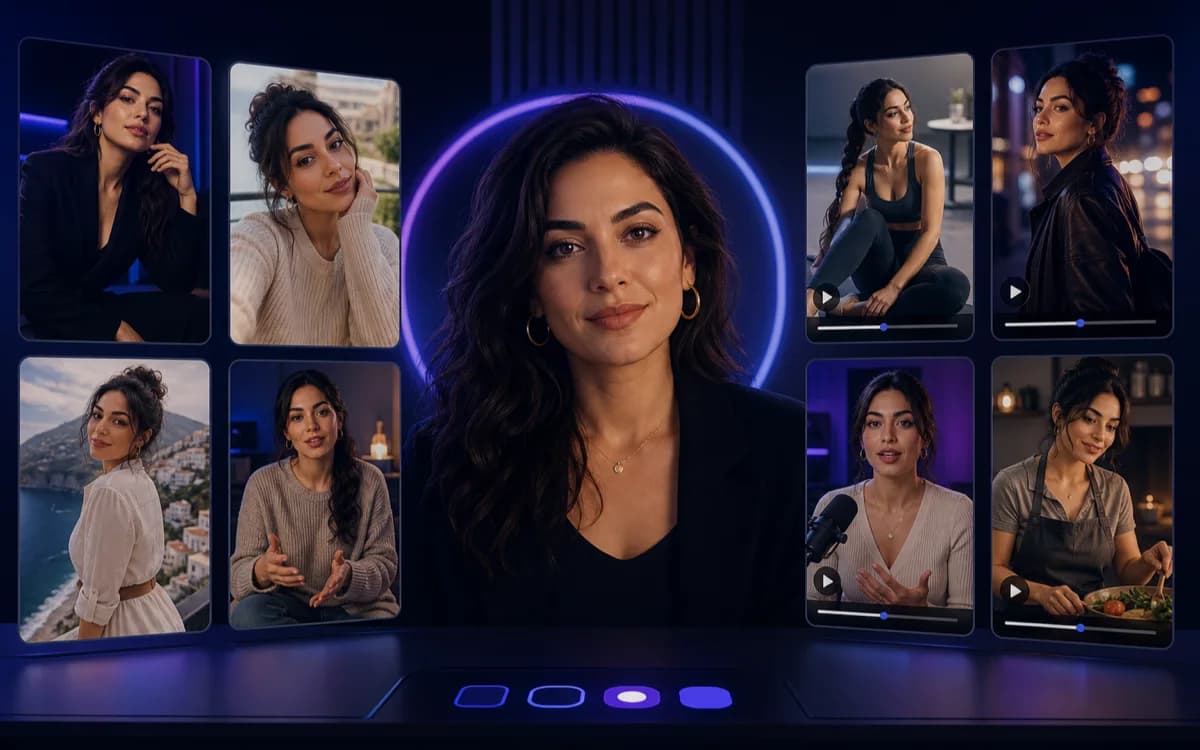
Ryla offers two broad starting paths: build a character from configurable attributes or provide a reference and, on supported plans, train a custom face model. The company says that trained identity can carry across studio photos, lifestyle scenes, reels, and talking content. Ready-made character previews can reduce the work before a first test.
Treat the site's absolute consistency claims as a hypothesis, not proof for your account. Every identity system can struggle with large changes in angle, light, age cues, hair, full-body proportion, hands, products, speech, and motion. Generate a fixed seven-output batch and count drift rather than judging two curated examples.
Use the consistent-character workflow to lock the apparent age, face, hair, proportions, wardrobe rules, camera language, and disclosure plan before testing Ryla or any alternative.
Photos, templates, voices, and video
Ryla's clearest workflow advantage is reducing blank-page production. The public product describes more than 100 ready-made templates spanning fashion, lifestyle, fitness, travel, beauty, editorial, dance, selfie, driving, talking, and other social formats. Users can also write a custom scenario when the template library does not fit.
Video features include photo-to-video, reels, transitions, lifestyle clips, video swap, talking-head generation, lip sync, and an AI Voice Engine. Ryla says the voice workflow supports many languages and regional accents and can use a selected voice or an authorized voice clone. Every voice and face still requires permission, review, and platform-appropriate disclosure.
Compare the motion output with the AI influencer video checklist. Look for facial stability through motion, lip timing, teeth, blinking, hand movement, background warping, crop safety, audio rights, and whether a video is genuinely publishable after the first frame.
- Photo studio: scenes, outfits, lighting, crops, and social-ready images
- Templates: prebuilt concepts that reduce prompt-writing work
- Video: image-to-video, reels, transitions, talking heads, and video swap
- Voice: lip sync, synthetic voices, multilingual output, and authorized cloning
- Export: creator assets intended for major social and fan platforms
Ryla AI pricing and credits in July 2026
Ryla's current English page showed a free start with 500 credits and one influencer. Its standard monthly prices were $34.99 for Basic with 10,000 credits, $99.99 for Pro with 25,000 credits, and $199.99 for Agency with 75,000 credits. Basic included unlimited characters plus video and talking-head generation. Pro added 4K output and custom face-model training. Agency advertised the highest allowances and an API marked as coming soon.
Another live Ryla page variant showed 1,000 free credits and first-month promotional prices of $29.99, $79.99, and $149.99 before the higher recurring figures. That makes the live signup and checkout the source of truth. Confirm the trial balance, promotional duration, renewal price, refund window, and feature access before paying.
The public credit table showed 100 credits for a photo, 3,000 for video, 200 for face swap, and 2,500 for lip sync on the research date. Ryla also described plan-level output estimates that do not map perfectly to one universal per-generation cost, likely because modes vary. Use the cost displayed immediately before the action. The FAQ says unused paid credits roll over while the subscription remains active.
| Standard monthly plan | Public allowance on July 17, 2026 |
|---|---|
| Free | 500 credits and 1 influencer on the current English page |
| Basic — $34.99 | 10,000 credits, unlimited characters, video, and talking heads |
| Pro — $99.99 | 25,000 credits, 4K, custom face-model training, and priority support |
| Agency — $199.99 | 75,000 credits, expanded customization, and agency-level support |
Commercial rights, safety, and disclosure
Ryla's current Terms of Service say users retain rights to generated content and may use it commercially, while granting Ryla a limited license to process, store, and display content to provide the service. The terms also say Ryla does not use generated content to train models without explicit consent. The product FAQ describes commercial ownership for premium-account imagery, video, and voice models.
Those statements do not create rights to an input the user never owned. The user remains responsible for every uploaded likeness, voice, video, product, logo, and claim. Ryla's public safety FAQ says non-consensual deepfakes and celebrity impersonations are prohibited. Use an original adult identity or documented consent and keep source records.
Ryla markets content for Instagram, TikTok, YouTube, Fanvue, and other channels. Publishing access does not remove platform rules. Label synthetic media where required, disclose sponsorship clearly, do not clone a voice or face without permission, and do not use any “anti-detection” feature or message as a reason to conceal AI involvement.
Ryla AI strengths
Ryla has a clear, creator-specific product story. Character configuration, one-click templates, photo and video studios, lip sync, voices, and platform formats live in one experience. That can be much easier than combining a base image model, LoRA trainer, editor, upscaler, video model, lip-sync system, and export tool independently.
The free entry point makes a basic workflow inspection possible. Paid-credit rollover can also be more forgiving than platforms whose recurring credits disappear every month, provided the subscription remains active and the current policy still applies.
Ryla AI limitations and watch-outs
The first limitation is evidence. Ryla's strongest claims—perfect consistency, perfect hands, professional realism, fast audience growth—are marketing statements or illustrative examples, not guarantees for a new account. A proper trial should include difficult angles, full-body scenes, product interaction, speech, and motion.
The second limitation is public-page consistency. Free-credit counts and promotional price displays currently differ between page variants. Output estimates and the displayed per-action credit table also require mode-level verification. Save the actual checkout, credit cost, and refund terms shown to your account.
Finally, templates are a production shortcut, not a creator strategy. The operator still needs a differentiated point of view, content pillars, captions, cadence, community, distribution, offers, analytics, and brand-safety review. Use the AI influencer content calendar to expose that work. Ryla can make the media; it cannot guarantee followers or revenue.
Ryla vs Clout
Choose Ryla when the bottleneck is generating many consistent photos and short-form clips through prebuilt templates with relatively little prompting. It is the stronger public fit for custom face-model training, voice, video swap, 4K output, and a large ready-made scene library.
Choose Clout when the harder problem is shaping one original creator into a coherent public brand. Clout connects the persona to content pillars, weekly batches, launch, and monetization direction. Use the best AI influencer generator comparison to see both platforms in the wider market.
Ryla AI review verdict: is it worth it?
Ryla is worth testing for creators who want a focused AI influencer builder, template-led photos, talking and motion workflows, and fewer technical model decisions. The free entry point is useful for inspecting character setup and basic generation before choosing a paid tier.
It is not automatically the best choice for someone whose gap is strategy rather than production. Test identity across a complete batch, record the live credit cost and renewal terms, verify commercial rights for the selected inputs and plan, and list every step still required to turn exported media into a growing creator business.
If your priority is a guided original persona, content system, launch, and revenue direction, build the AI influencer in Clout and compare the complete weekly workflow with Ryla's template-led production path.