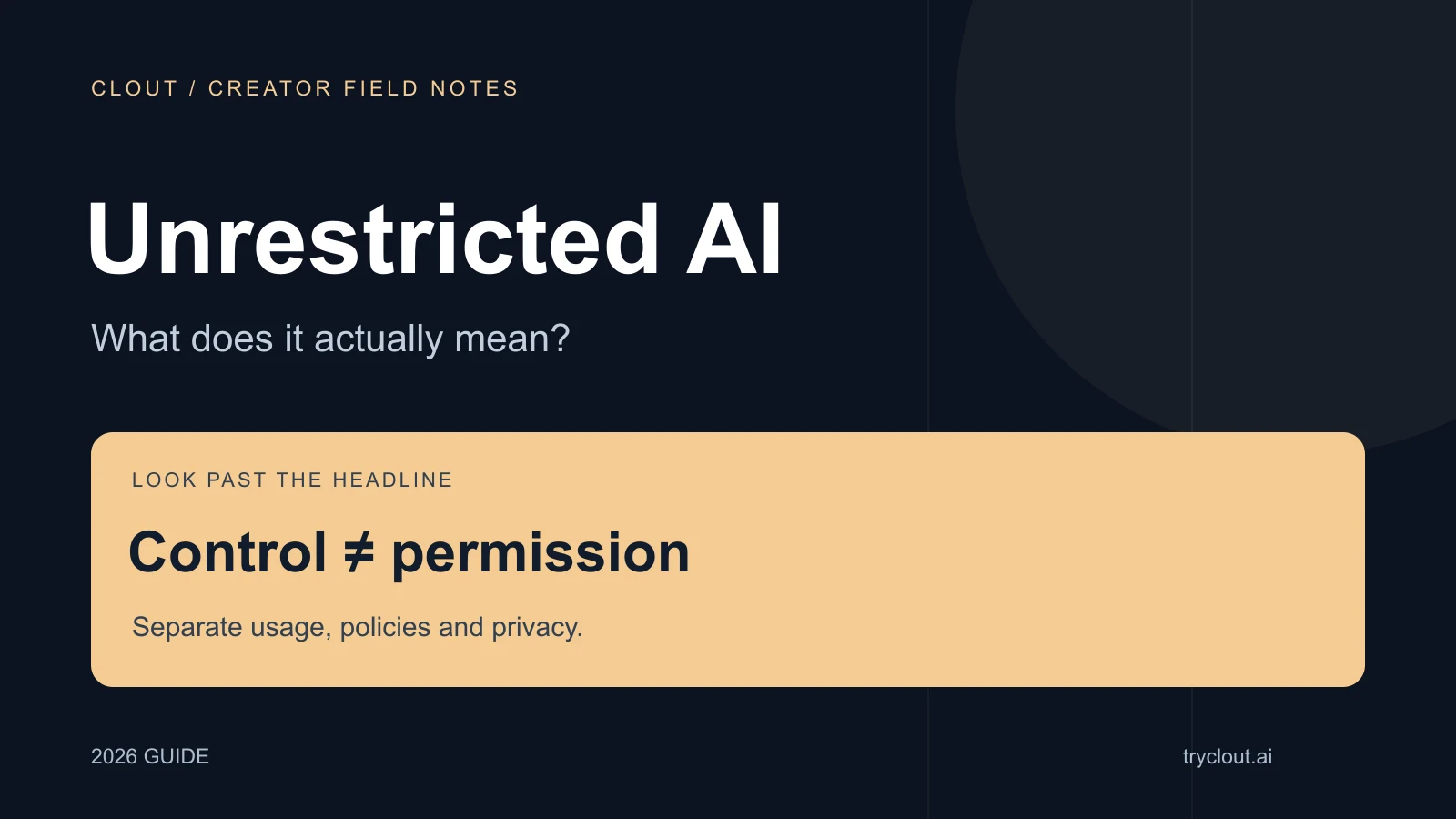
Unrestricted AI sounds like one clear promise, but it can describe several different things. A buyer might want flexible photo edits, more generations, control over models or fewer content restrictions. Those requirements need separate answers.
This guide explains the term for people evaluating image and video production. If you are researching one specific platform, use our ZenCreator review. If you want help editing a reference image, use the ZenCreator editor guide.
Four meanings to separate before you choose a tool
| Meaning | Question to ask | Evidence to inspect |
|---|---|---|
| Creative control | Can I direct the scene, pose, background and style? | Current editor controls and a trial with your own brief. |
| Usage freedom | Are there daily caps, queues or metered charges? | Billing terms and the quote for the exact operation. |
| Content permissions | What inputs and outputs does the service allow? | The current acceptable-use policy, rather than a headline. |
| Technical control | Can I select models or automate the workflow? | Documented settings, API behavior and export options. |
A tool can offer flexible editing and still meter every generation. It can provide model choice and still apply content rules. None of those combinations is inherently contradictory. The problem is treating a broad advertising phrase as a precise specification.
Put the guide to work
Build your AI creator in Clout
Create a reusable persona, generate social-ready photos and videos, and turn one character into a repeatable content system
A real example: ZenCreator’s public-page conflict
ZenCreator’s unrestricted editor page advertises editing without content filters. Its content policy, dated August 4, 2026, states that sexually explicit content is prohibited and describes automated pre-generation screening. Both pages were publicly accessible when checked on September 6, 2026.
This establishes a conflict in the published descriptions. It does not establish which requests currently pass or fail in the application. Before relying on an advertised permission, check the policy and seek clarification from the provider when those sources disagree. A headline is not sufficient evidence for an operating assumption.
Unrestricted does not mean unlimited or free
Separate the ability to submit a job from the cost of completing it. Your total spend depends on the operation, settings, number of attempts and outputs you actually approve. An account with flexible usage can still be expensive for repeated revisions.
Write down the size of the batch you need, the maximum amount you intend to spend and the minimum acceptable result. Then run a small sample. If a scene needs several attempts, use that observed rate when planning the rest of the project instead of assuming every generated file is useful.
Privacy is a separate question
Do not infer how uploads are handled from a claim about creative freedom. Inspect the provider’s explanation of storage, deletion, access and training use. These describe different parts of a workflow; one favorable statement does not answer all of them.
For a client project, establish which source assets you are permitted to upload before evaluating an editor. If a requirement matters to the project, record the source and the date you checked it. That gives your team something concrete to revisit when terms or features change.
How is unrestricted AI different from NSFW AI?
NSFW means “not safe for work,” a context label that can include sexual material or other sensitive content. Unrestricted describes a claimed absence of limits. Neither phrase identifies one standard model or guarantees what a service will allow.
For public-facing creator production, decide what you need to publish before choosing a generator. An original lifestyle persona, a product scene and an explicit-content request are different jobs. Our existing NSFW AI guide for social creators covers the distinction and the non-explicit alternative workflow.
A better evaluation brief for creator content
- One original adult character with a stable reference set.
- Three non-explicit scenes with different backgrounds and the same recognizable identity.
- One product detail that must remain accurate.
- A target crop and resolution for the finished assets.
- A spending limit and an acceptance checklist agreed before the test.
Review continuity, edit fidelity and usable outputs per dollar. Those observations tell you more about production fit than whether the word “unrestricted” appears on a homepage. Use our same-character guide to plan the reference set and our editor comparison to distinguish the jobs different tools address.
Clout’s proposition is a repeatable creator workflow. If that is your goal, evaluate the whole content series rather than optimizing for an ambiguous promise about limits.
Build an original AI creator in Clout and evaluate one persona across a complete content series.