

Google Co-Director is a research framework for agentic video storytelling. It searches over creative directions and refines production artifacts rather than treating one prompt and one returned clip as the whole filmmaking job. This guide follows the public Ads Co-Director implementation and provides a local explorer for its fully observed UCB selection arithmetic.
The source is pinned to revision e5f12b07a8fc39baadcb9e654f8a5e26faf059cd, committed October 22, 2026. We executed its standalone Python selector with authored fixtures and compared 72 stage selections with our browser helper. We did not run the cloud media pipeline, generate a Co-Director video or reproduce the paper’s quality benchmark.
What Google Co-Director is
The Google Research article introduces Co-Director alongside related continuity research. The Co-Director paper was submitted in April 2026; the research blog appeared in September. The October source revision is a code observation, not a claim that the underlying paper was newly released that day.
The project targets coherent multi-shot storytelling, including product advertisements with constraints that must survive from the brief through the final sequence. An individual attractive frame can still fail the job if it changes a product, omits the intended action or breaks the narrative between shots.
This guide follows the public Co-Director implementation. For a general shot-planning task, use the existing AI storyboard guide. The explorer here studies how a particular source selector ranks the next creative experiment after observations exist.
Separate the three creative choices
The pinned configuration separates creative strategy, narrative mode and aesthetic archetype. There are three strategy choices, three narrative choices and four aesthetic choices. That makes 36 possible combinations, but the factored selector maintains observations for each dimension rather than treating every combination as an independent arm in one flat list.
| Dimension | Configured choices | Question for an original product scene |
|---|---|---|
| Creative strategy | Informational transformational comparative | Should the message explain a feature evoke an experience or contrast a baseline |
| Narrative mode | Analytical vignette narrative drama | Should the sequence argue show moments or resolve a conflict |
| Aesthetic archetype | Clarity energy cinematic premium minimalist focus kinetic grit | What visual and pacing language supports the message |
Do not confuse those choices with a delivery format or a video model. A narrative drama still needs a specific character, action, continuity plan and approved ending. A cinematic-premium direction still needs readable product details and a sound plan appropriate to the actual campaign.
Understand the public production workflow
The source README divides work into pre-production, production and post-production. Its agent module uses Google ADK agents, tool calls and loops. The configuration selects UCB, four global iterations and local storyline and keyframe refinement settings. Those values describe the pinned example configuration; inspect your own copy before assuming it uses the same limits.
Pre-production turns the brief into a storyline, casting and storyboard. Production establishes keyframes and generates video and audio through service calls. Post-production assembles the timeline. The source’s generation tools contain Gemini image and text calls and Veo video calls. Reading those calls does not prove that your account, region, quotas or chosen model identifiers can execute them.
A configured iteration count is not a price quote and not a guarantee of that many accepted videos. Model calls, retries, rejected artifacts and local refinement can affect work and cost. Inspect the service configuration and current provider requirements before enabling a cloud run. This local explorer never invokes those services.
Try the creative search explorer
The default observations are authored examples. For every choice, they provide a mean score and an attempt count. The coefficient starts at 50, matching the pinned configuration’s UCB parameter. Expand Edit observed scores and attempts to change the observations, then inspect the selected choice in each dimension.
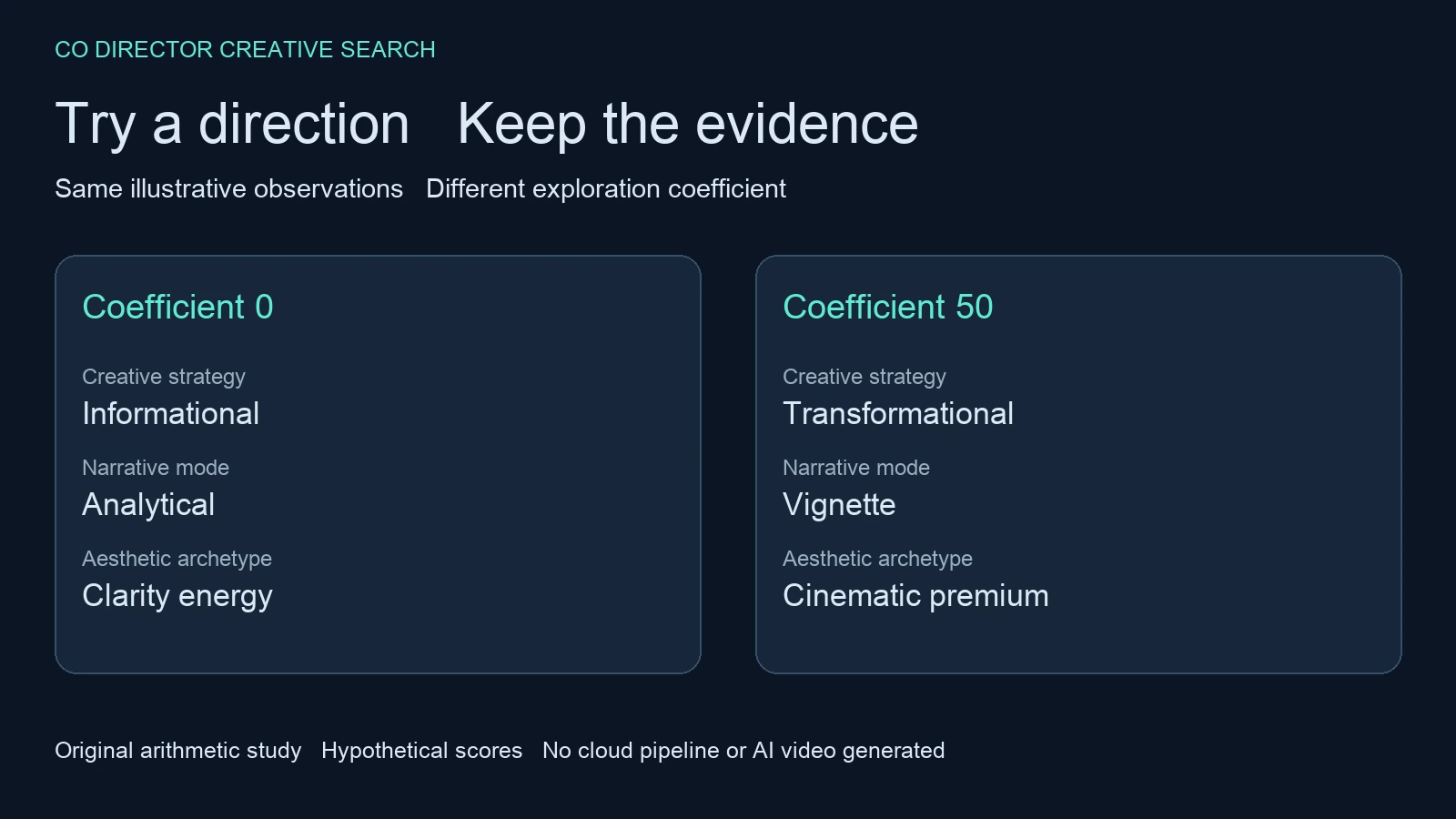
With the default data, coefficient zero selects Informational, Analytical and Clarity energy because they have the highest illustrative means. At coefficient 50, the explorer selects Transformational, Vignette and Cinematic premium because less-tested choices receive larger exploration bonuses. Neither result says which actual video will be better.
The UCB value is mean reward + c × square root of (natural log of total stage attempts / attempts for the choice). It is a selection score, not a probability. The exploration bonus can make the value exceed 100 even when all supplied mean scores lie between zero and 100.
The explorer requires one to 10000 attempts for every choice. It does not model cold start. In the public selector, unobserved choices follow a separate path that can prioritize a recommendation or randomly choose an untried arm. Supplying a zero-attempt row to this tool blocks the export instead of pretending that the fully observed formula applies.
Keep scores tied to the artifact that earned them
A mean without a review protocol can be misleading. Preserve the brief, creative choices, source references, output identifier, reviewer evidence and rejected artifacts for each attempt. Use the same score definition when comparing observations. A high visual score should not silently replace a failed product-identity or factual-claim check.
The source can use dimension-specific efficacy scores with a global-score fallback. That is part of its credit-assignment design. Our explorer starts from the supplied means and counts and calculates the next fully observed selection. It does not reproduce the verifier prompts, award quality scores or implement the complete source state machine.
Download the JSON to keep the assumptions and selected choices together. The CSV includes each arm’s attempts, mean, exploration bonus and UCB value. It is an experiment record, not a campaign-performance forecast or an automatically accepted production plan.
Plan an original narrative drama test
For a fictional insulated cup, define a short three-beat action: a commuter reaches for a drink, discovers the lid is loose, then secures it before leaving. Keep the cup’s silhouette, lid color and the hand performing the action explicit across the shots. Do not invent an insulation or spill-proof claim that the actual product has not substantiated.
An analytical version might explain a verified lid mechanism with a controlled close view. A vignette version might show three separate everyday uses with the same product. A narrative-drama version needs the problem and resolution to remain legible. Those are distinct creative experiments even when they use the same approved reference.
Create original source imagery in Clout Marketing Studio or build a short scene in Clout Cinema. Inspect the actual output before advancing the sequence. This is a practical way to organize a test; it does not claim an automatic Clout-to-Co-Director integration or a completed source framework run.
Compare Co-Director with CANVAS research
Google’s research article also discusses CANVAS, whose paper focuses on continuity-aware visual storyboarding. Character identity, persistent background anchors and location-aware planning are relevant to a coherent sequence, but CANVAS is a separate research framework. The Co-Director selector experiment on this page does not execute CANVAS.
When reviewing an AI drama or product film, keep continuity evidence concrete: the same item remains in the same hand, a doorway remains on the intended side and the resolved action follows the preceding shot. A numeric selector can help allocate a next experiment; it cannot substitute for watching the finished narrative.
Reproduce the source selector comparison
The pinned public source folder includes the agent, configuration, bandit classes and production tools. Its Apache-licensed code is separate from our original fixtures and explanatory artwork. The source audit records document URLs and hashes.
We imported only the standalone bandit module and executed 24 authored fully observed fixtures. All 72 selected stage choices matched our TypeScript helper. A separate source check confirmed a recommended unobserved choice; that cold-start behavior remains outside the browser UI. No cloud model or media service was called.
Download the authored fixtures, selection validation, default search record, default CSV and zero-coefficient reference. Follow the reproduction notes with the local helper and inspect the asset hashes.


