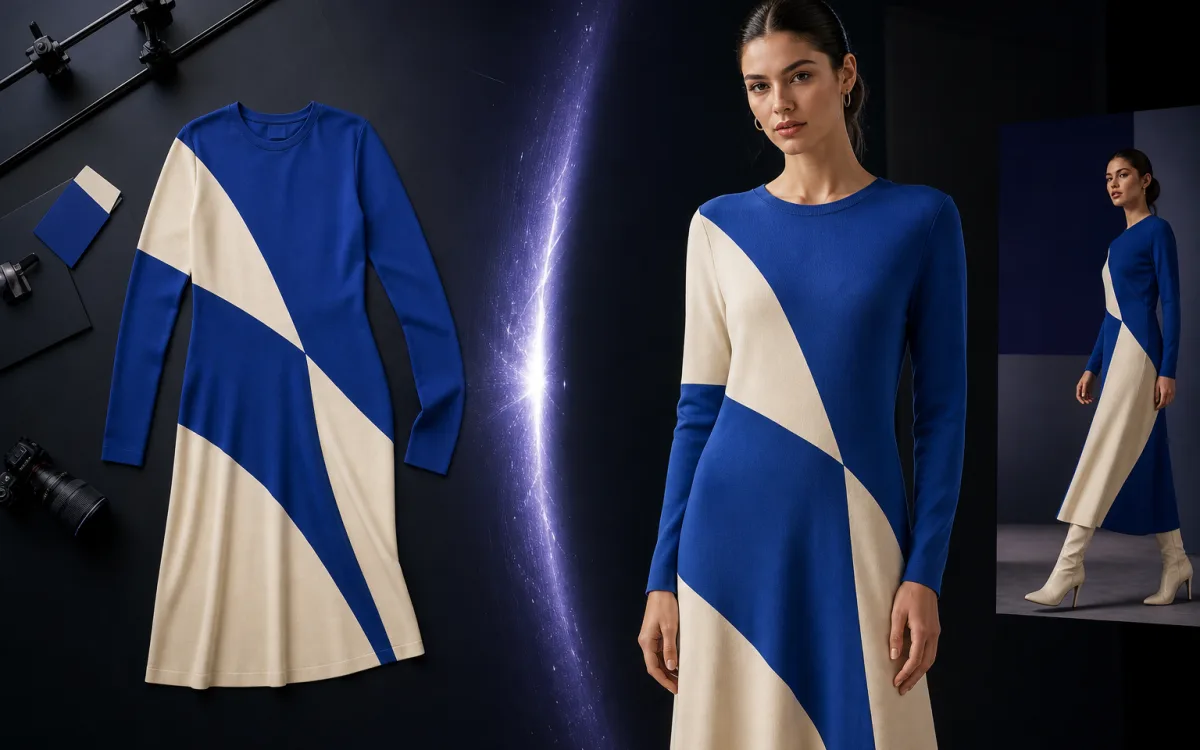
This Botika review starts with the job the product actually performs. Botika is not a general text-to-image playground and it is not primarily an AI influencer business builder. It is a fashion-production platform designed to turn clothing photos into on-model ecommerce, editorial, social, and short video assets.
That specialization can be valuable for apparel brands, but it also creates clear limits. This independent review examines the live public workflow, credits, pricing signals, strengths, constraints, and the difference between Botika and a recurring virtual creator platform such as Clout.
What is Botika?
According to Botika's official product page, the platform helps fashion brands upgrade clothing photos into on-model images or video. Its public examples cover ecommerce product pages, editorial assets, social media, paid campaigns, and collection launches.
The core system is garment-led. A user supplies an owned on-model photo, flat lay, or mannequin image, selects a virtual model, pose or background where supported, and receives a new fashion visual. Botika says its models are fully AI-generated and its technology is trained specifically around fashion details such as fabric flow, fit, and poses.
- Primary audience: clothing brands, retailers, marketplaces, creative teams, and fashion agencies
- Primary inputs: on-model, flat-lay, and mannequin clothing photos
- Primary outputs: on-model catalog images, campaign variations, editorials, social assets, and short video
- Workflow character: curated selections rather than unrestricted text prompting
How Botika's AI fashion workflow works
For an existing on-model photo, Botika can replace the person while keeping the pose and body configuration. For flat-lay or mannequin inputs, the user can choose a model, pose, and background for the generated visual. The platform also turns clothing imagery into short motion clips.
The current Botika FAQ says processing takes about 15 minutes, although actual delivery and repair times depend on the workflow and plan. The FAQ also says unsupported files do not consume credits. Buyers should test their most difficult real inputs rather than assume every garment or crop is supported.
| Botika workflow | What to verify in a trial |
|---|---|
| On-model replacement | Face, hair, pose, body, garment, accessories, and background integrity |
| Flat lay to model | Print, seams, fabric drape, fit, front/back accuracy, and color |
| Mannequin to model | Neckline, sleeve, hem, proportions, and hidden garment geometry |
| AI fashion video | Garment stability, body motion, hands, background continuity, and usable duration |
| Bulk catalog production | Turnaround, failures, corrections, downloads, and cost per approved SKU |
Where Botika is strongest
Botika has a narrow value proposition compared with broad generative studios: take an actual apparel asset and produce more usable fashion imagery without coordinating a complete physical shoot. That is easier to evaluate than an open-ended promise because a merchant can compare the generated output directly against the source garment and existing photography standard.
The platform also reduces prompting decisions. The public FAQ says self-serve users choose from Botika's internally developed models and backgrounds rather than creating anything through free-form prompts. Teams that want predictable production can see that as a benefit, particularly if they do not employ a specialist prompt or generative-art operator.
For a broader market view, compare it with the best AI fashion model generators using one fixed set of difficult garments.
Botika limitations and tradeoffs
The specialization also defines what Botika is not. The self-serve FAQ says users cannot create custom models or backgrounds or freely alter model makeup, hairstyle, and expression. Botika's enterprise plan separately advertises exclusive models and backgrounds, so organizations that need custom brand assets should confirm the enterprise scope rather than assume it is included in self-serve tiers.
Botika currently focuses on clothing. Its FAQ says jewelry, footwear, and cosmetics are not part of the standard focus, while accessories in an uploaded image may be removed or changed. Flat-lay and mannequin outputs also demand careful review because any generated fashion system can misread a logo, pattern, strap, seam, sleeve, or fabric behavior.
Finally, catalog imagery and a creator brand are different systems. Botika can generate social-ready fashion assets, but the public product does not define a creator niche, point of view, content calendar, audience promise, publishing plan, or monetization model.
Teams that need creator-led product demonstrations should compare that catalog workflow with the AI UGC creator workflow, which starts from the message and recurring persona rather than the SKU image.
- Limited self-serve model and background customization
- Clothing-first scope rather than every accessory or beauty category
- Potential changes to unsupported accessories or fine garment details
- Credits and correction access depend on plan and generation type
- Creator strategy, captions, scheduling, community, and monetization remain separate
Botika pricing and credits
On July 17, 2026, Botika's product page advertised paid access starting at $25 per month. Its official pricing page displayed Lite, Pro, Advanced, and Enterprise tiers, monthly and yearly controls, and a 17% annual discount. Because plan cards and credit allowances can render dynamically, verify the exact live checkout instead of relying on an old screenshot or third-party review.
Botika's current FAQ says a no-card trial includes eight credits, each generated photo costs one credit, and each generated video costs five credits. It also says unused credits roll over while a subscription remains active, annual plans receive all credits upfront, and one-off top-up packs may be available from the billing area.
Calculate the total cost per approved SKU: every angle, video, rejected generation, correction, retouch, download, and human review. A nominal one-credit photo is inexpensive only when the garment is accurate enough to publish.
Botika vs Clout
Botika and Clout can both produce fashion-oriented AI imagery, but they start from different assets and lead to different businesses. Botika starts with a garment photo and optimizes toward on-model catalog or campaign content. Clout starts with a fictional creator identity and optimizes toward recurring social posts, first frames, video concepts, launch assets, and monetization direction.
Choose Botika when the product must remain the center of the image and the recurring job is publishing apparel SKUs. Choose Clout when the person must remain the center of the brand and the recurring job is publishing a recognizable virtual fashion creator. The complete Clout vs Botika comparison includes a buyer-decision table and test plan.
| Primary requirement | Better starting point |
|---|---|
| Flat lay or mannequin to on-model catalog imagery | Botika |
| Garment-led batch production for ecommerce | Botika |
| Curated fashion models and backgrounds with fewer prompt decisions | Botika |
| One reusable virtual creator across ongoing social content | Clout |
| Persona, niche, content plan, launch, and monetization guidance | Clout |
How to test Botika before paying
Use a controlled benchmark. Include a clean solid garment, a fine knit, a busy print, a visible logo, front and back views, challenging sleeves or straps, and an accessory that should remain unchanged. Follow the review method in the AI fashion model workflow.
Generate the exact angles and formats your store needs. Review the output at full resolution, then place it inside the real product-page crop and mobile layout. Record turnaround, unsupported inputs, credits, correction requests, and cleanup time.
- Compare garment color under the same display conditions
- Inspect prints, typography, seams, edges, fasteners, and brand marks
- Check that the image does not imply a fit or feature the product does not have
- Review hands, footwear, jewelry, and other details near the garment
- Confirm current commercial rights, source-photo rights, privacy, retention, and cancellation terms
Botika review verdict
Botika is a credible specialist for apparel teams that want more on-model catalog and campaign content from clothing photos they already own. The fashion-specific workflow, curated model library, flat-lay and mannequin support, short video, bulk use cases, and plan-dependent corrections target real ecommerce production bottlenecks.
It is a weaker fit for buyers who need unrestricted character design, custom self-serve personas, broad product categories, or a complete creator-business system. Clout is the more relevant alternative when fashion is the niche of one recurring AI influencer rather than the subject of a product catalog.
If you want to build a recognizable fashion creator rather than replace a catalog photoshoot, use the consistent-character test, then create your original AI influencer in Clout.