A beautiful bag on a pedestal can establish taste, but a shopper still needs to understand why that bag belongs in their life. Luxury handbag advertising has to balance atmosphere with evidence. Show the proportions, demonstrate the closure and make a matching pouch feel useful rather than decorative.
If you searched for top performing Meta ad examples for luxury handbags and sets, separate creative inspiration from performance evidence. A public ad can show a hook, format and visual treatment. It does not give you your own purchase conversion rate or profit. The six examples here are original campaign concepts to produce and test, with a fictional unbranded bag as the visual planning reference.
Download the original handbag campaign concept
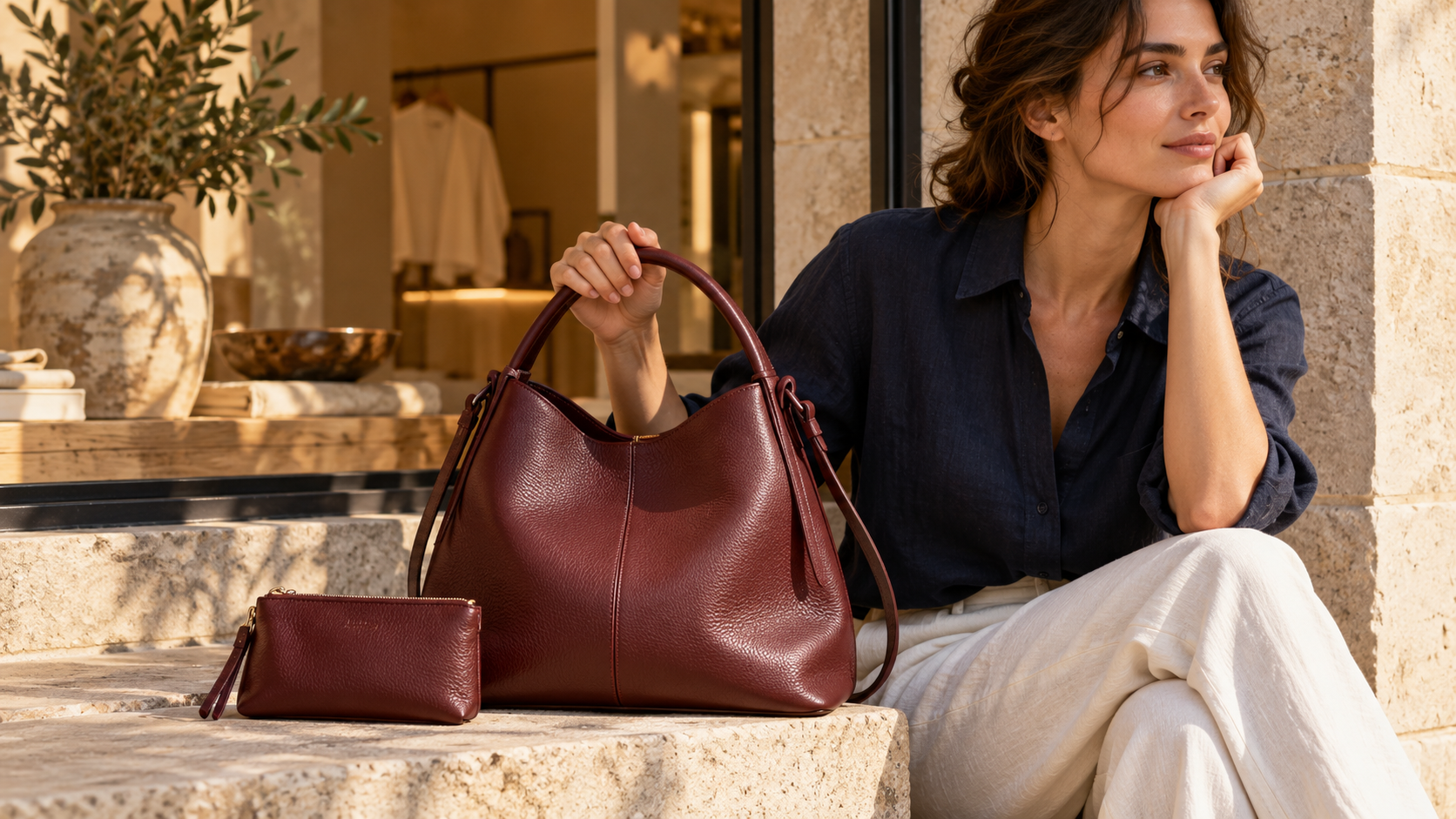
Original AI-generated fictional product concept for creative planning. Replace it with accurate references of the product you sell before producing customer-facing ads.
Download handbag campaign referenceSix handbag ad concepts with a clear job
| Concept | Opening hook | Shots to produce | What it answers |
|---|---|---|---|
| The daily essentials | Everything I actually carry | Open bag, place familiar objects, close without strain, shoulder view | Capacity and everyday usefulness |
| One bag across three outfits | One bag from morning to evening | Same creator and bag with work, lunch and evening outfits | Styling flexibility |
| The matching set | The little pouch earns its place | Bag and pouch together, keys or cosmetics inside pouch, transfer to another tote | Why buy the set |
| The construction close-up | Look at the details before you choose | Handle attachment, edge finishing, stitching, lining, closure | Material and build confidence |
| Scale in motion | Here is how it actually sits | Front, side and walking view with strap length held constant | Size and carrying comfort |
| The quiet gift reveal | A gift with a daily purpose | Open packaging, reveal set, place it on a dressed shoulder | Gift context without a fake testimonial |
Choose one concept per first test. Combining capacity, gifting, craftsmanship and a discount in the same short edit makes it harder to learn what persuaded the shopper. Keep the product page aligned with the ad: a capacity hook should land on real dimensions and interior photographs, while a set hook should make the included pieces obvious.
A practical fifteen-second shot plan
For the matching-set concept, use the first three seconds to show both pieces together. From seconds three to seven, show the pouch doing one useful job, such as keeping keys separate. From seven to eleven, place it inside the bag and show the closure. Use the last four seconds for the bag on a shoulder and a concise shopping invitation. Those timings are a planning example, not a rule for every placement.
Original production brief: Film the oxblood bag and matching pouch in natural boutique-window light with the same adult creator across all shots. Preserve the handle shape, hardware, dimensions and leather color from approved product references. Use one slow hand action per shot. Show the pouch fitting inside the bag without altering either object. Leave room for a short hook in the opening frame.
Generate each shot separately so a failed closure or distorted strap can be replaced without rebuilding the entire concept. Where tactile accuracy matters, use real product footage for the detail and demonstration shots. AI can help with a campaign environment or creator styling, but it should not invent the inside of your bag.
Research competitors without inventing their results
Use the Meta Ad Library as a creative research destination. Record the brand, the date you observed the ad, its opening frame, claim, product view, offer and destination. Keep a screenshot or permalink in your internal worksheet when available. An observed ad is inspiration; calling it a winner needs performance evidence that the public creative alone does not supply.
Translate the research into a hypothesis rather than a copy. For example: “Our shopper needs a size reference before considering the bag.” Then create an original scale demonstration using your own product and creator. Reusing another brand's photos, distinctive campaign or customer story weakens the relevance of your test.
Build a measurement sheet before launching
| Field | What to record |
|---|---|
| Hypothesis | The exact buying question the creative answers |
| Control and variant | Your existing creative and one changed concept |
| Delivery | Dates, spend, audience, placements and impressions |
| Attention | Available watch and click measures, with the same definitions |
| Commercial result | Purchases, purchase value, returns and contribution after costs |
| Decision | Continue, revise or stop, with a stated reason and uncertainty |
Set an acceptable acquisition cost from your own unit economics. Use contribution after product cost, fulfillment, fees and expected returns, not just the selling price. A matching set may lift order value while also increasing product cost; compare like for like. Do not choose a winner from a few inexpensive clicks when the campaign's job is purchases.
As an arithmetic example, a creative with $300 in spend and five attributed purchases has a reported acquisition cost of $60. That number alone does not establish profitability or a statistically reliable advantage. Attribution settings, time window, order margin and small samples all affect the decision. Keep the calculation visible rather than replacing it with an invented ROAS promise.
Review the finished product before publishing
Check every visible frame against the real bag. Inspect handle joins, clasp position, strap length, pouch size and color under the selected light. Read any material claim against the manufacturer's actual specification. Avoid generated customer quotes, fake scarcity and endorsements. Finally, check the ad on a phone with its placement interface visible so the hook and shopping invitation remain readable.
Create a campaign creator in Clout and develop photos and videos around an approved product brief. Keep the creator consistent while changing the question each ad answers.