

AI history videos work best when the story begins with a narrow question and a source record. AI can help draft a script, explore illustration styles and prepare narration, while the creator keeps dates, people and events tied to evidence.
This guide includes an original narrated vertical short about the Wright brothers’ four flights on December 17, 1903. Download the script, claim ledger, captions and editable source. The finished example uses explanatory graphics and mechanical demo narration; it is not archival footage or a Clout-generated story render.
Choose one event and one clear question
A useful short asks something specific enough to answer within its runtime. Our question is how the first and fourth flights differed that morning. That gives the story a beginning, a comparison and a closing lesson without inventing dialogue or an unseen dramatic incident.
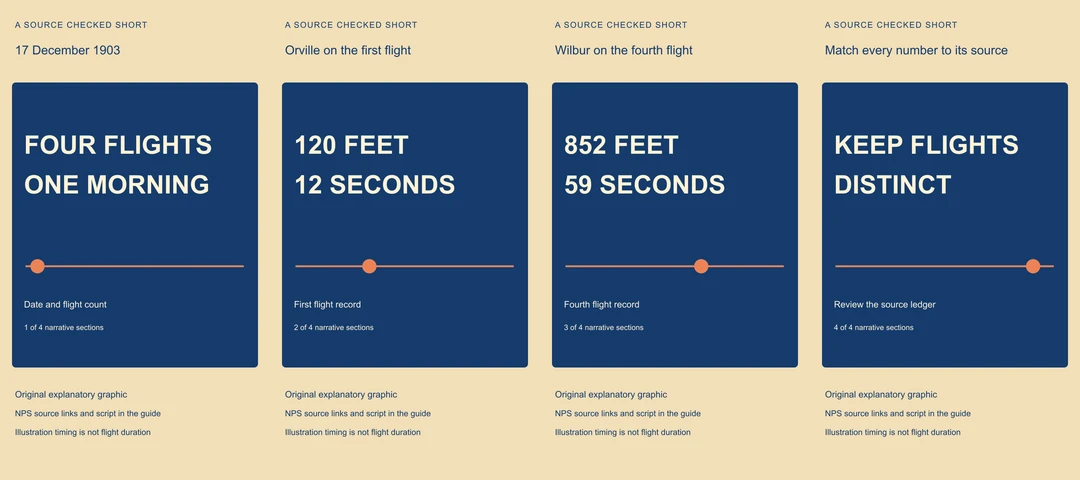
The National Park Service flight record lists four successful powered flights that morning. Its first-flight numbers are 120 feet and 12 seconds; its fourth-flight numbers are 852 feet and 59 seconds. The NPS narrative account identifies Orville at the first flight and Wilbur on the fourth.
These are two institutional pages from the same organization, not two independent original eyewitness records. They are useful for this bounded exercise. A deeper historical argument would need a broader evidence base and attention to disagreements between sources.
Build a claim ledger before writing the narration
Give every historical statement a claim ID, source URL and place in the script. Keep your own interpretation separate from the sourced event. Our filled claim ledger maps the date, flight order, pilots, distances and durations to the selected NPS passages.
| Claim | Historical detail | Production decision |
|---|---|---|
| Day | Four successful powered flights on December 17 1903 | Open with the date and count |
| First flight | Orville with 120 feet and 12 seconds | Keep these numbers on the first-flight card |
| Fourth flight | Wilbur with 852 feet and 59 seconds | Give the fourth flight its own card |
| Conclusion | Flight order matters when using the numbers | Label this as our editorial lesson |
Check each draft sentence against the ledger. A fluent script can accidentally attach the fourth flight’s distance to the first pilot. The words may sound natural while the event becomes wrong. Resolve that before making the visuals or voice track.
Watch the original narrated history short
Watch this clip and view its details
The supplied MP4 is 720 by 1280, 29.5 seconds long and 708 frames at 24 FPS. Its four sections follow the source ledger. The audio is local eSpeak NG demo synthesis from the supplied narration text, not a historical recording or a sample of Clout’s narration quality.
Download the narrated MP4, scene-level captions and editable script JSON. The timing map records each scene’s frame boundaries and narration duration. The short’s runtime is separate from the historical flight durations discussed inside it.
Use AI illustrations without turning them into evidence
Decide whether each visual is an archival item, an interpretation, an explanatory graphic or a proposed reconstruction. Those roles need different review. A pleasing illustration is not evidence that a machine, uniform or location looked that way.

The paper biplane above was deliberately made as a generic concept. It has wheels and a conventional nose propeller. The NPS descriptions of the 1903 Flyer discuss its launching rail, skids and pusher propellers. We therefore use the paper plane as general editorial art, not as a depiction proving the aircraft’s historical design.
The downloadable video uses original typographic graphics for the numerical comparison. The line and circles mark sections of the narration; they do not represent a geographical route, elevation or measured flight path. The visual-review CSV keeps these decisions with the assets.
Write a production brief from the verified script
Create a short educational narrative about the four flights on December 17 1903. Keep Orville’s first flight separate from Wilbur’s fourth. Preserve the supplied dates, distances and durations. Use clearly identified explanatory graphics or reviewed illustrations. Do not invent eyewitness dialogue or present a generated scene as archival footage.
This is an original production brief. It is not a submitted provider request. If you use a generative video model, inspect the actual returned scenes against the brief and source notes before accepting them.
For a Clout faceless workflow, the read-only creative catalog checked for this guide includes Editorial motion and Watercolor chronicle styles. Choose a style available in your selected route, prepare the script and inspect the proposed settings and cost. Catalog availability alone does not prove that a finished story will preserve every historical detail.
The Clout Faceless Studio is the product starting point. Our sample here is independently authored with supplied narration files, so it should not be used as a benchmark of a Clout generation run. For a fictional dramatic narrative instead, use the AI Cinema workflow and keep the fictional premise clear.
Review narration captions and scene order together
Read names and numbers aloud before finalizing the voice track. Then inspect the actual rendered audio, not just its input text. A pronunciation problem, rushed sentence or truncated ending is an audio issue even when the script is correct.
Check that the right card stays visible while its statement is spoken. Our source script pads each supplied narration segment before moving on and records the resulting duration. The captions are scene-level cues rather than word-by-word karaoke timing.
Review the full export at the intended viewing size. Confirm that dates and units remain readable, source links remain available in the accompanying page or description, and transitions preserve the event order. Our local checks cover decoding, frame timing, audio duration and caption boundaries; browser playback and human listening review are separate checks.
Download and adapt the original production pack
The editable source archive includes the four supplied narration WAVs, script, rendering code, claim ledger and visual review. Run bun install and bun history-short-source.ts . with FFmpeg installed. The supplied environment uses Sharp 0.34.5 and FFmpeg 9.0.1.
The included WAVs let you rebuild the edit without installing a speech engine. If you replace the narration, rerun the timing step and inspect the new captions and scene boundaries. Do not keep an old timing map after changing the audio.
For the next history short, duplicate the ledger structure and research a different bounded question. Keep archive rights, illustration roles and source claims with the project. A repeatable workflow should make it easier to verify the next story, not simply produce more scenes.


