People who search “how to make AI girl model” usually want more than one attractive image. The first decision is not the hair color or image model. It is whether you are building a one-off picture or a creator people can recognize across an entire feed.
This workflow is for an original fictional adult character. Give the persona a clearly adult age, never copy a real person's face or body without explicit permission, and plan the identity around content you can publish lawfully and disclose honestly.
Step 1: Define the adult AI model's job
A strong AI model has a content job. She might be a streetwear creator, skincare educator, fitness personality, travel storyteller, gaming host, product demonstrator, or fictional founder. The niche determines the locations, outfits, poses, props, camera language, and revenue opportunities you will need later.
Write one sentence that combines audience, subject, and point of view. For example: “A 25-year-old fictional outdoor creator who makes beginner hiking feel stylish and approachable.” That sentence is more useful than a long list of facial features because it tells every asset what it is trying to communicate.
Put the guide to work
Build your AI creator in Clout
Create a reusable persona, generate social-ready photos and videos, and turn one character into a repeatable content system
Step 2: Build an identity sheet
Create a short identity sheet before generating anything. Keep it specific enough to recognize and flexible enough to support many posts.
- Clearly adult age: choose a specific age of 18 or older
- Face: shape, eyes, brows, nose, lips, and one recognizable detail
- Hair: cut, texture, color, and normal styling variations
- Body and proportions: realistic, adult, and consistent
- Wardrobe rules: silhouettes, colors, jewelry, and what to avoid
- Camera language: selfie, editorial, candid, studio, or documentary
- Niche and tone: what she talks about and how she sounds
- Boundaries: prohibited likenesses, claims, settings, and content
Step 3: Generate the reference set
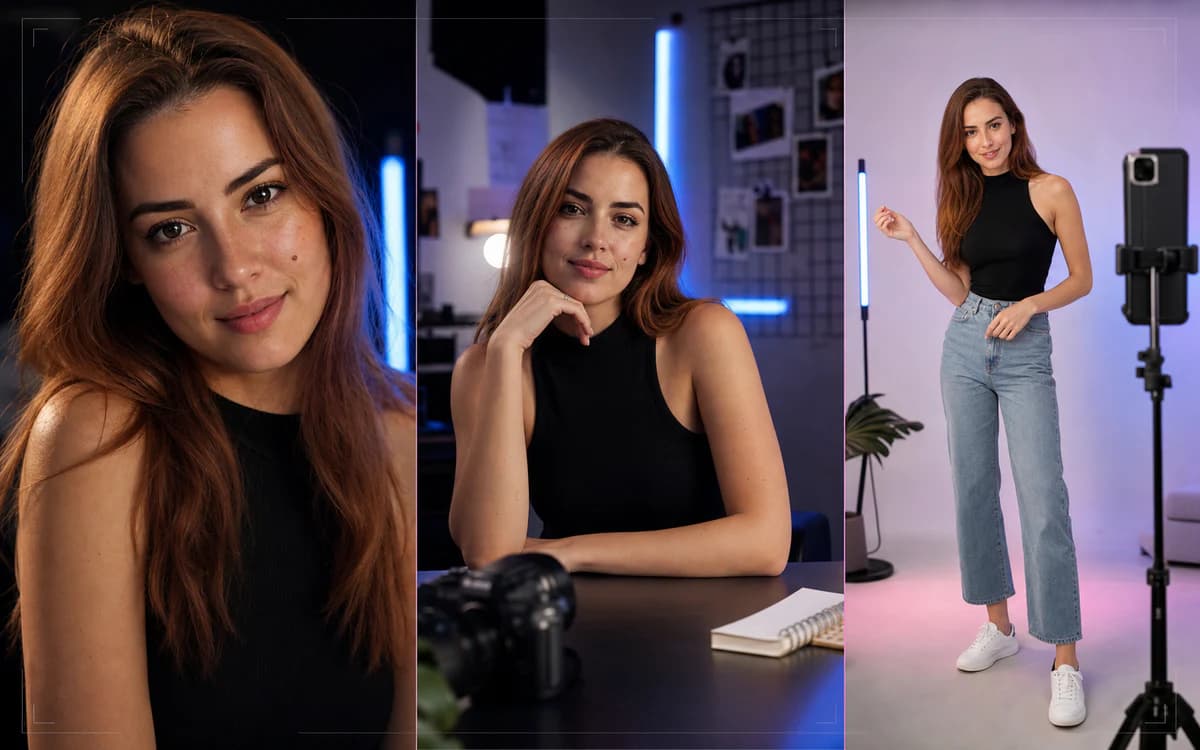
Use an AI influencer generator to create a clean reference set before producing campaign content. Start with neutral portraits: front-facing, three-quarter, profile, waist-up, and full-body. Use simple lighting and avoid props that hide the face or hands.
Choose a small set that looks like the same adult person. Do not select images only because they are individually beautiful. Reject any frame that changes the eye spacing, jawline, age, hairline, or body proportions.
Step 4: Test consistent character AI
Character consistency has to survive change. Follow the consistent character AI workflow and generate the persona in several scenes while changing only one major variable at a time.
| Change this | Keep this stable |
|---|---|
| Location | Face, age, hair, proportions, and niche |
| Outfit | Identity references, camera style, and realism |
| Product | Creator expression, visual tone, and disclosure rules |
| Pose or crop | Recognizable facial structure and body type |
| Still image to video | Identity, lighting logic, and scene continuity |
Step 5: Create a launch batch, not random posts
Build the first account as a coordinated set. A practical launch batch includes profile and banner assets, three niche-defining posts, three lifestyle posts, two opinion or education posts, two product-ready concepts, and several vertical first frames for short-form video.
Use the 30-day AI influencer content calendar to turn that batch into a publishing rhythm. Reuse the same core visual language so the feed teaches viewers who the creator is before you ask them to follow or buy.
Step 6: Move the AI girl model into video
Begin with a strong first frame that already looks like the persona. Add small, plausible motion before attempting long or complex performances. Natural head movement, a camera push, a product gesture, or a short walk is easier to keep consistent than a scene with several cuts and costume changes.
The image-to-video AI guide explains how to preserve the identity anchor while testing motion. Review every clip for face drift, hands, teeth, background warping, lip movement, and whether the action fits the creator's niche.
Step 7: Disclose, protect, and publish responsibly
Do not present the persona in a way that deceives people about endorsements, qualifications, or real-world experiences. Follow the AI or synthetic-media disclosure tools required by each platform and clearly label sponsored content.
Keep the project defensible: use original or licensed inputs, save permission records, avoid real celebrity or private-person likenesses, do not sexualize anyone under 18 or whose age is ambiguous, and review local rules before commercial use.
Step 8: Connect the model to a revenue path
An AI girl model becomes a creator business only when the niche connects to an offer. Read the AI influencer monetization guide and choose one primary path: brand partnerships, affiliate content, fan subscriptions, digital products, services, or a product brand.
The offer should fit the persona's established expertise and audience. A hiking creator can sell trip plans or promote outdoor products. A beauty creator can make UGC-style demos or build a preset pack. Consistency earns attention; a credible offer turns that attention into revenue.
How Clout simplifies the workflow
Clout turns this process into three stages: shape the persona, produce on-brand content, and launch with a monetization direction. The identity stays at the center, so you are not rebuilding the adult fictional creator from a blank prompt for every post.
That is the difference between making an AI girl image and building an AI influencer. One creates a file. The other creates a repeatable identity, content system, and business asset.
Create your original adult AI model in Clout and turn the first identity into a consistent launch batch.